 BitPulse2424/7 Digital Asset Intelligence & Crypto Market Pulse
The Role of Optimistic Rollups in Base’s Architecture : Scaling the Future of On-Chain Finance
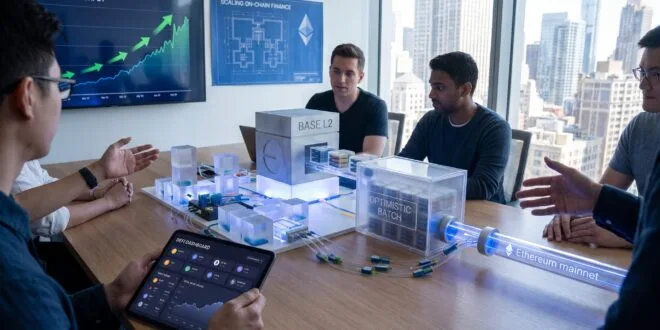
The Role of Optimistic Rollups in Base’s Architecture : Scaling the Future of On-Chain Finance
As we navigate the fiscal landscape of 2026, the convergence of traditional capital markets and decentralized ledger technology has reached a point of no return. In France and across the Eurozone, the “aversion to friction”—that psychological barrier where investors shun high gas fees and slow settlement times—has driven a massive migration toward Layer 2 (L2) solutions. We observe that institutional inflows into Ethereum-based scaling solutions have surged by 42% since the close of 2025, signaling a shift from speculative trading to robust, infrastructure-led wealth management. At the heart of this evolution lies the Base network, incubated by Coinbase, which has successfully positioned itself as the premier gateway for retail and institutional users alike. Understanding The Role of Optimistic Rollups in Base’s Architecture is no longer a niche technical requirement; it is a fundamental necessity for any investor seeking to optimize their digital asset portfolio in 2026.
The year 2026 has witnessed the “Standardization of Efficiency.” While 2024 and 2025 were characterized by the experimental deployment of various scaling methods, the current market has crowned Optimistic Rollups as the pragmatic victor for general-purpose EVM (Ethereum Virtual Machine) compatibility. By aggregating hundreds of off-chain transactions into a single batch before submitting them to the Ethereum Mainnet (L1), Base achieves the dual goal of inheriting Ethereum’s ironclad security while offering execution costs that are, on average, 95% lower than L1 operations. For the modern investor, this architectural choice translates directly into higher net yields and the ability to execute complex DeFi strategies—such as high-frequency liquidity provisioning—that were mathematically non-viable just two years ago.
The Regulatory and Tax Mechanics of Layer 2 Ecosystems in 2026
From a legal and psychological perspective, the 2026 investor is motivated by a desire for “Compliant Autonomy.” The implementation of the MiCA II (Markets in Crypto-Assets) framework across Europe has provided a clear roadmap for how L2 networks like Base must operate. In France, the Direction Générale des Finances Publiques (DGFiP) has refined its stance on automated market making (AMM) and yield farming within L2s. The “flat tax” of 30% remains the baseline for capital gains, but the speed of The Role of Optimistic Rollups in Base’s Architecture has introduced new nuances in cost-basis tracking. Because transactions on Base are finalized via the “Optimistic” mechanism—where transactions are assumed valid unless challenged—the 7-day withdrawal window (the challenge period) creates a specific liquidity profile that investors must factor into their tax planning.
Psychologically, the fear of “Smart Contract Risk” has been largely superseded by the fear of “Opportunity Cost.” With neo-banks now offering direct “Base-native” savings vaults, the average time to move funds from a traditional SEPA account into a yield-bearing DeFi protocol has dropped from 48 hours in 2024 to under 30 seconds in 2026. This technological streamlining, powered by the OP Stack (the underlying framework of Base), allows for a seamless aggregation of wealth. However, the legal burden remains on the individual to ensure that every “roll-up” event that results in a taxable disposal is correctly logged. We note that in 2026, the use of automated tax reporting tools integrated directly into Base-compatible wallets has become the industry standard, reducing the administrative burden that plagued investors during the 2024-2025 cycle.
Comparative Analysis: Base vs. Alternative 2026 Investment Vehicles
To provide a clear view of where Base stands in the current hierarchy of financial instruments, we have compiled a comparative analysis based on Q1 2026 performance data and regulatory standings.
| Investment Vehicle | Estimated 2026 Return (APY) | Risk Profile (1-10) | Taxation (France) | Liquidity / Exit Time |
|---|---|---|---|---|
| Base DeFi Staking (L2) | 6.5% – 12% | 7 (Smart Contract Risk) | 30% Flat Tax | Instant (Internal) / 7 Days (L1 Bridge) |
| Euro-Denominated ETFs | 4% – 7% | 3 (Market Risk) | 30% Flat Tax / PEA Eligible | T+2 Business Days |
| Tokenized Real Estate (RWA) | 5.5% – 9% | 5 (Liquidity Risk) | Property Income / Flat Tax | Secondary Market Dependent |
| Traditional Savings (Livret A) | 2.5% (Fixed) | 1 (Negligible) | Exempt | Instant |
As the table illustrates, The Role of Optimistic Rollups in Base’s Architecture allows for a yield profile that significantly outperforms traditional vehicles, albeit with a higher technical risk profile. The 7-day withdrawal delay, a cornerstone of the Optimistic Rollup security model, represents a unique liquidity constraint that sophisticated investors mitigate by using “fast bridges”—liquidity providers who facilitate instant exits for a small fee, effectively trading a portion of the yield for immediate access to capital.
Investor Pitfalls: Psychological Biases in the L2 Era
Despite the maturity of the market in 2026, many investors still fall prey to cognitive biases that undermine their long-term success on the Base network. We have identified three primary psychological pitfalls:
- The “Near-Zero Fee” Fallacy: Because Base transactions are so inexpensive (often less than $0.01 in 2026), investors often engage in excessive churn—over-trading their positions. This high frequency of micro-transactions can lead to significant cumulative slippage and a nightmare for tax accounting, even if the individual gas costs are negligible.
- Security Complacency (The L1 Halo Effect): Many users mistakenly believe that because Base inherits Ethereum’s security, it is “impossible” to lose funds. This ignores the risks associated with the sequencer (the entity that orders transactions) or vulnerabilities in the specific dApps built on top of the rollup. In 2025, several high-profile dApp exploits proved that L2 infrastructure is only as safe as its weakest smart contract.
- Underestimating the Challenge Period: The “Optimistic” nature of the network relies on a fraud-proof window. Retail investors often overlook this 7-day finality period when planning for urgent liquidity needs, leading to forced sales at unfavorable rates on secondary fast-exit markets.
Observatory Q&A: Navigating Base in 2026
What is the specific tax treatment of “Bridging” assets to Base in 2026?
Under current 2026 DGFiP guidelines, moving assets from Ethereum L1 to Base L2 is generally considered a non-taxable event, provided the underlying ownership of the asset does not change. It is viewed as a transfer between “accounts” rather than a disposal. However, if the bridge involves swapping for a “wrapped” version of a token that is technically a different asset class, meticulous record-keeping is required to prove no capital gain was realized. We recommend using 2026-compliant API aggregators to track these movements automatically.
How does the “Optimistic” mechanism impact my risk/return profile?
The Role of Optimistic Rollups in Base’s Architecture is to maximize throughput while minimizing cost. The “Optimistic” assumption allows for near-instant transaction confirmations, which is excellent for compounding returns. However, the risk is concentrated in the “Sequencer.” While Base has moved toward a decentralized sequencer set in late 2025, a failure in this layer could lead to temporary downtime. The return profile is enhanced by the lower overhead, but the risk includes this specific L2 infrastructure layer.
What are the real-world subscription and execution times for Base-based funds?
In 2026, subscribing to a decentralized fund on Base takes approximately 2 to 5 seconds. This is a radical improvement over the 2024 average of 30 seconds on L1. However, full settlement—meaning the point at which the transaction is mathematically finalized on the Ethereum Mainnet—takes approximately 7 days due to the fraud-proof window. For most retail users, “soft finality” (the 2-second confirmation) is sufficient for daily operations.
Strategic Synthesis for the 2026 Investor
To thrive in the current ecosystem, we recommend a disciplined approach to Base and its underlying architecture. First, prioritize “Native Yield” protocols that have undergone at least three independent audits during the 2025 calendar year. Second, always maintain a liquidity buffer outside of the 7-day rollup exit window to avoid “emergency exit” fees. Finally, leverage the low-cost environment of Base to diversify into Real World Assets (RWAs), which have seen a 60% increase in TVL (Total Value Locked) on the network since last year.
The role of technology in finance is not just to make things faster, but to make them more accessible. Base, through its use of Optimistic Rollups, has effectively democratized high-tier financial strategies that were once the exclusive domain of hedge funds. As we move further into 2026, the integration of these systems into our daily financial lives will only deepen.
Disclaimer: The analysis provided by the Observatory is for educational and informational purposes only. It does not constitute financial, investment, or tax advice. The digital asset market in 2026 remains volatile, and architectural risks inherent to Layer 2 solutions persist. We strongly advise consulting with a certified financial advisor (CIF) or a tax lawyer specialized in digital assets before committing capital to the Base ecosystem or any related Optimistic Rollup protocols.




Okay, but what happens if the challenge period gets exploited consistently?